
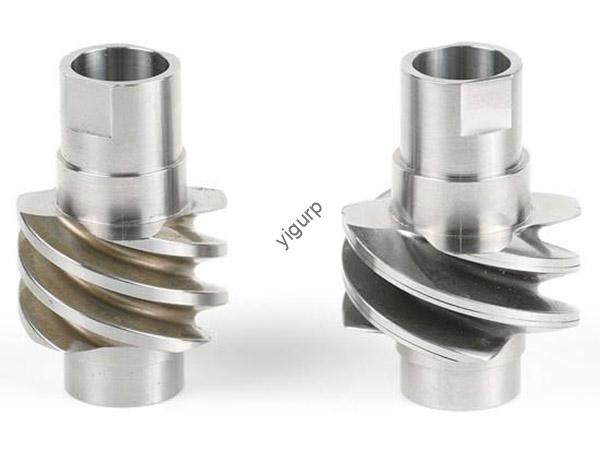
When your project involves heavy machinery, automotive transmissions, or any application where components face constant stress and sudden impacts, you need a steel that combines exceptional strength with reliable toughness. EN24 structural steel is a high-strength alloy steel designed for exactly these demanding conditions. Its carefully balanced composition and heat treatment deliver the mechanical properties required for critical components that must not fail. This guide breaks down everything from its chemical makeup to its real-world performance, helping you decide if it is the right choice for your next project.
What Makes EN24 a High-Performance Alloy?
EN24 is a nickel-chromium-molybdenum steel, defined by the European standard EN 10083-3. Its performance comes from a precise combination of alloying elements that, after proper heat treatment, create a material with outstanding strength, toughness, and fatigue resistance. It is often described as a “through-hardening” steel, meaning it can be hardened uniformly even in thick sections.
The Chemistry of Strength and Toughness
The table below shows the typical composition of EN24 and the role each element plays in its performance.
| Element | Content Range (%) | Key Function |
|---|---|---|
| Carbon (C) | 0.36 – 0.44 | Provides core hardness and tensile strength after heat treatment. |
| Nickel (Ni) | 1.30 – 1.70 | Boosts impact resistance, especially at low temperatures. A key contributor to toughness. |
| Chromium (Cr) | 0.90 – 1.20 | Increases wear resistance, hardenability, and toughness. |
| Molybdenum (Mo) | 0.15 – 0.25 | Improves hardenability and fatigue resistance. Prevents temper brittleness. |
| Manganese (Mn) | 0.60 – 0.90 | Enhances ductility and weldability. |
| Silicon (Si) | 0.10 – 0.40 | Improves heat resistance during fabrication and strengthens the steel matrix. |
| Phosphorus & Sulfur | ≤ 0.050 each | Strictly controlled to prevent brittleness and cracking. |
Key Mechanical Properties
EN24’s mechanical properties are achieved through quenching and tempering—a heat treatment process that creates a balanced microstructure. The values below are typical for the quenched and tempered condition.
| Property | Typical Value | Why It Matters |
|---|---|---|
| Tensile Strength | 800 – 1000 MPa | Withstands high pulling forces without breaking. Suitable for shafts, axles, and gears. |
| Yield Strength | ≥ 600 MPa | Resists permanent deformation under load. Critical for structural and rotating components. |
| Impact Toughness | ≥ 50 J at -40°C | Remains tough in cold environments. Will not crack under sudden shock loads. |
| Fatigue Resistance | ~400 MPa | Handles repeated stress cycles, such as in rotating shafts or transmission gears. |
| Hardness | 240 – 300 HB (as treated) | Can be increased with heat treatment. Balances wear resistance with machinability. |
| Elongation | ≥ 12% | Moderate ductility allows for some forming without cracking. |
A real-world example: A Danish wind energy company used EN24 for its 2.5 MW turbine shafts. These shafts face constant rotation at 1500 RPM and variable wind loads. After 5 years of operation, inspections showed no signs of fatigue cracking. Without EN24’s high fatigue resistance, the shafts would have required replacement every 2 years , significantly increasing downtime and maintenance costs.
Where Is EN24 Used?
EN24’s combination of high strength, toughness, and fatigue resistance makes it a preferred material for critical components across multiple industries.
Mechanical Engineering
- Gears: Used in industrial gearboxes for conveyor systems, cranes, and heavy machinery. A German manufacturer uses EN24 for its 10-ton gearboxes. The EN24 gears last 50% longer than carbon steel gears in the same application.
- Shafts: Powers pumps, turbines, and compressors. The steel’s fatigue resistance prevents cracking from constant rotation.
- Axles: Supports heavy machinery like forklifts and mining equipment, where high yield strength is essential.
Automotive Industry
- Transmission Components: Gear sets and drive shafts in trucks and SUVs. A U.S. truck brand uses EN24 for its transmission shafts, which handle 300+ horsepower without failure over hundreds of thousands of miles.
- Suspension Parts: Shock absorber mounts and control arms that must withstand road impacts and vibrations.
Industrial and Construction
- Heavy Machinery Bearings: Used in large electric motors and industrial equipment where hardness and wear resistance are critical.
- Structural Components: Heavy-duty beams in industrial buildings that support overhead cranes and heavy loads.
- Bridge Components: Beams and columns in bridges that carry heavy truck traffic, relying on EN24’s high tensile strength.
Railway and Shipbuilding
- Freight Train Wheels and Axles: A Japanese truck manufacturer switched to EN24 for its transmission gear sets. Previously, carbon steel gears failed after 100,000 miles. EN24 gears now last 200,000+ miles , cutting maintenance costs by 40% .
- Ship Components: Hull components for small cargo ships that must resist wave impacts and collisions.
How Is EN24 Manufactured?
EN24 requires precise manufacturing processes, with heat treatment being the most critical step to unlock its full potential.
| Stage | Common Method | Why It Matters |
|---|---|---|
| Steelmaking | Electric Arc Furnace (EAF) or Basic Oxygen Furnace (BOF) | Allows precise addition of nickel, chromium, and molybdenum to meet the required alloy composition. |
| Forming | Hot rolling (1150-1250°C) or forging | Hot rolling creates bars, plates, and sections. Forging is used for complex shapes like gear blanks and shafts, refining the grain structure. |
| Heat Treatment | Quenching (830-860°C, oil) + Tempering (500-600°C) | This is critical. Quenching creates a hard martensitic structure. Tempering reduces brittleness and achieves the final balance of strength and toughness. |
| Annealing | Heat to 820-850°C, slow cool | Softens the steel for easier machining before final heat treatment. |
| Welding | Arc welding with preheating (200-300°C) | EN24 has fair weldability. Preheating is essential to prevent cracking. Post-weld heat treatment is recommended to relieve residual stress. |
How Does EN24 Compare to Other Materials?
Choosing EN24 means understanding its advantages over alternatives. This comparison helps clarify where it fits.
| Material | Tensile Strength (MPa) | Impact Toughness (-40°C) | Fatigue Resistance (MPa) | Relative Cost | Best For |
|---|---|---|---|---|---|
| EN24 | 800 – 1000 | ≥ 50 J | ~400 | 100% | High-stress gears, shafts, axles |
| Carbon Steel (A36) | 400 – 550 | ≤ 20 J | 200 – 250 | ~50% | Low-stress structural parts |
| EN19 (Alloy Steel) | 620 – 780 | ≥ 40 J | 350 – 400 | ~70% | Medium-stress components |
| AISI 4340 | 800 – 1200 | ≥ 50 J | 400 – 450 | 110% | Ultra-high-strength aerospace parts |
| Stainless Steel (304) | 500 – 700 | ≥ 100 J | 250 – 300 | 250% | Corrosive environments |
Key takeaways:
- vs. Carbon Steel: EN24 is about twice as strong and has 2.5 times better impact toughness. It costs roughly twice as much but lasts 2 to 3 times longer in demanding applications.
- vs. EN19: EN24 is 25-30% stronger and has better impact resistance. Choose EN24 for higher-stress applications like main shafts and heavily loaded gears; choose EN19 for lighter-duty components.
- vs. AISI 4340: The two are similar. EN24 is often used as a European alternative to 4340. Both offer excellent strength and toughness.
Conclusion
EN24 structural steel is a premium material for applications where strength, toughness, and reliability are non-negotiable. Its nickel-chromium-molybdenum composition, combined with proper heat treatment, delivers tensile strength up to 1000 MPa, exceptional impact resistance at low temperatures, and outstanding fatigue life. While it requires careful welding and costs more than carbon steel, its proven ability to last 50-100% longer in demanding applications makes it a cost-effective choice for critical components. For gears, shafts, axles, and any part that must withstand heavy loads and repeated stress, EN24 offers a trusted, high-performance solution.
FAQ About EN24 Structural Steel
Can EN24 be welded without preheating?
No. Preheating to 200-300°C is required. EN24’s high carbon and alloy content makes it prone to cracking if welded cold. Post-weld heat treatment (such as stress relieving) is also recommended to restore toughness and prevent delayed cracking.
Is EN24 suitable for outdoor use?
It depends on the environment. EN24 has only moderate corrosion resistance—uncoated, it will rust in wet or salty conditions. For outdoor applications, it should be protected with a coating such as chrome plating, epoxy paint, or oiling. For continuous exposure to saltwater, a stainless steel grade would be more appropriate.
How does EN24 compare to EN19?
EN24 is stronger (tensile strength 800-1000 MPa vs. 620-780 MPa) and has better impact resistance (≥50 J vs. ≥40 J at -40°C). However, EN19 is cheaper and easier to weld. Choose EN24 for high-stress parts like turbine shafts, heavily loaded gears, and axles. Choose EN19 for medium-stress components like smaller gears, brackets, and beams.
What heat treatment is required for EN24?
The standard heat treatment is quenching and tempering. Austenitize at 830-860°C, quench in oil, then temper at 500-600°C. This achieves the desired balance of high strength and good toughness. For maximum wear resistance, temper at a lower temperature (around 400°C). For maximum toughness, temper at a higher temperature (around 600°C).
Discuss Your Projects with Yigu Rapid Prototyping
Selecting the right alloy steel for high-stress applications is a critical decision. At Yigu Rapid Prototyping, we have extensive experience supplying EN24 for gears, shafts, axles, and other demanding components. Our team can help you determine if EN24 is the right fit for your specific load, fatigue, and environmental requirements—or if a different grade like EN19 or AISI 4340 is more appropriate. We offer EN24 in bars, forgings, and custom-fabricated components with full heat treatment documentation and material certification. Contact us today to discuss your project and build with confidence.