
Our 3-Axis CNC Machining Services
Elevate your part production with our 3-Axis CNC Machining services—the reliable, cost-effective solution for precision components across industries.
Leveraging linear axes (X, Y, Z) for seamless 3D machining, we deliver consistent results for metals (stainless steel, aluminum), plastics, and composites—from automotive brackets to medical device prototypes. With efficient setup, versatile tooling, and tight tolerances, we turn your designs into high-quality parts fast, without compromising on performance.
Our 3-Axis CNC Machining Capabilities
We offer robust machining capabilities tailored to 3-axis systems, with a focus on precision, versatility, and tooling options to meet diverse project needs. Below is a detailed breakdown of our key capacities:
| Capability | Specification |
| Linear Axes Range | – X-Axis: Up to 1500mm- Y-Axis: Up to 800mm- Z-Axis: Up to 600mm |
| Maximum Part Size | 1500mm × 800mm × 600mm (L×W×H); Maximum weight: 300kg |
| Material Thickness | – Metals: Up to 100mm (stainless steel), 150mm (aluminum), 80mm (titanium), 120mm (brass)- Non-Metals: Up to 200mm (plastics), 180mm (composites), 150mm (wood), 100mm (acrylic) |
| Precision Levels | – Positioning accuracy: ±0.005mm- Repeatability: ±0.003mm |
| Custom Machining | – Features: Holes (minimum diameter: 0.5mm), slots, chamfers, 3D curved surfaces- Compatibility: CAD/CAM files (DXF, DWG, STEP, STL)- Volume: Prototypes (1–50 units) to high-volume (50,000+ units/month) |
| Tolerance Achievements | Meets ISO 2768-1 (fine grade); Critical parts (e.g., aerospace brackets) achieve ±0.008mm |
| Tooling Options | – End mills (carbide, high-speed steel): For milling slots, pockets, and 3D shapes- Drills (twist, spade): For hole making- Reamers: For precision hole finishing- Inserts (indexable): For high-volume turning/milling |
Whether you need to machine a single titanium medical bracket or 10,000 acrylic consumer goods parts, our 3-axis capabilities scale to match your project’s complexity and volume.
What Is 3-Axis CNC Machining?
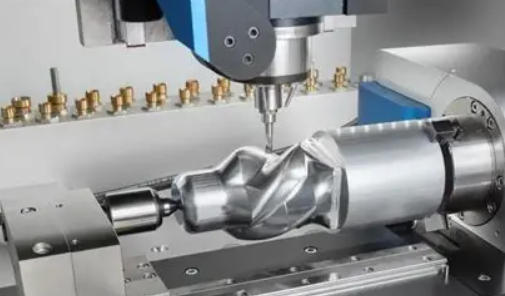
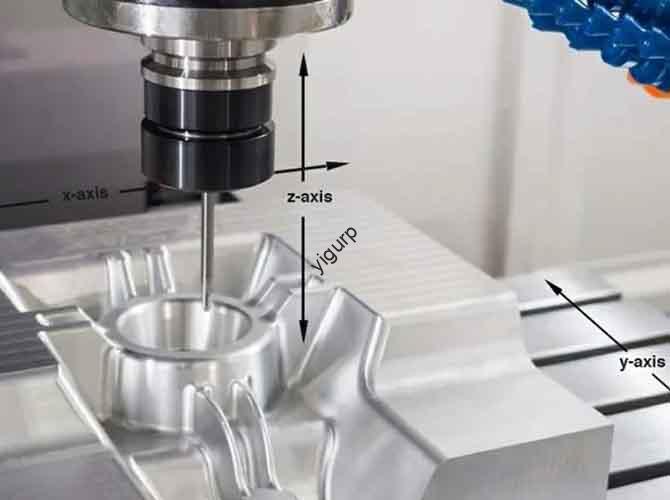
3-Axis CNC Machining is a foundational manufacturing technology that uses three orthogonal linear axes (X, Y, Z) to shape raw materials into 3D parts. Unlike manual machining or 2-axis systems (limited to flat surfaces), it relies on Computer Numerical Control (CNC) to automate tool movement along three dimensions:
- X-Axis: Left/right horizontal movement (across the machine bed).
- Y-Axis: Forward/backward horizontal movement (perpendicular to the X-axis).
- Z-Axis: Up/down vertical movement (controls the cutting tool’s depth into the material).
The process overview is intuitive: A CNC system interprets a digital design (CAD file) to generate instructions for the machine. The cutting tool (e.g., mill, drill) moves along the X/Y/Z axes to remove material from the workpiece, creating features like holes, slots, or curved surfaces.
To explain “how it works” simply: Imagine a high-precision drill that can move left/right, forward/backward, and up/down—all guided by a computer. For example, when making a plastic electronics enclosure, the machine first uses the X/Y axes to position the tool, then the Z-axis to cut the enclosure’s outline, and finally repeats the process to add holes for ports. This simplicity, paired with automation, makes 3-Axis CNC Machining the workhorse of modern manufacturing.
The 3-Axis CNC Machining Process (Step-by-Step)
Our step-by-step process is optimized for efficiency and precision, guiding your project from design to finished part:
- Design and CAD Modeling: We start by reviewing your CAD model (or creating one from sketches). Our engineers optimize the design for 3-axis machining—e.g., ensuring 3D features are accessible via X/Y/Z movements (avoiding undercuts that require more axes). For prototypes, we offer free design feedback to improve manufacturability.
- CAM Programming: The CAD model is imported into CAM software (Mastercam, SolidWorks CAM), where we generate tool paths—the exact routes the cutting tool will take along the X/Y/Z axes. We select tools based on material (e.g., carbide end mills for titanium) and program speeds/feeds to balance precision and efficiency.
- Setup and Calibration: The workpiece is secured to the machine bed using custom fixture design (e.g., vises for small parts, clamps for large sheets). We calibrate the X/Y/Z axes using laser measuring tools to ensure alignment—critical for consistent results. Cutting tools are loaded into the machine’s tool changer, and coolant systems are activated.
- Machining Execution: The CNC system runs the CAM program, automating tool movement along the X/Y/Z axes. For example, when milling an aluminum bracket, the tool first moves along X/Y to outline the part, then uses the Z-axis to cut pockets and drill holes. Our operators monitor the process in real time to adjust coolant flow or tool speeds if needed.
- Post-Machining Inspection: After machining, parts undergo rigorous checks. We use CMMs (Coordinate Measuring Machines) to verify dimensions against the CAD model, check surface finish with profilometers, and ensure tolerances are met. Parts requiring finishing move to deburring or polishing steps.
Materials We Work With
3-Axis CNC Machining excels with a wide range of materials—from hard metals to lightweight non-metals. Below is a breakdown of our supported materials, their key properties, and ideal uses:
| Material Category | Examples | Key Properties | Ideal Applications | Machining Notes |
| Metals | Stainless Steel | Corrosion-resistant, strong | Medical instruments, aerospace brackets | Use carbide tools; high-pressure coolant reduces heat |
| | Aluminum | Lightweight, easy to machine | Automotive parts, electronics enclosures | Fast cutting speeds; minimal tool wear |
| | Titanium | High strength-to-weight, heat-resistant | Orthopedic screws, aircraft components | Slow speeds; sharp tools prevent wear |
| | Brass | Malleable, conductive | Electrical connectors, decorative parts | Fast speeds; produces smooth finishes |
| | Copper | Highly conductive, soft | Heat exchangers, wiring terminals | Use coolant to avoid melting; sharp tools |
| Non-Metals | Plastics (ABS/Polycarbonate) | Lightweight, durable | Consumer goods casings, prototypes | Low speeds to prevent warping |
| | Composites | High strength, lightweight | Industrial panels, drone frames | Specialized carbide tools to avoid fraying |
| | Wood | Natural, cost-effective | Custom furniture, decorative pieces | Sharp tools; vacuum fixtures secure parts |
| | Acrylic | Transparent, rigid | Display cases, signage | Low feed rates to prevent cracking |
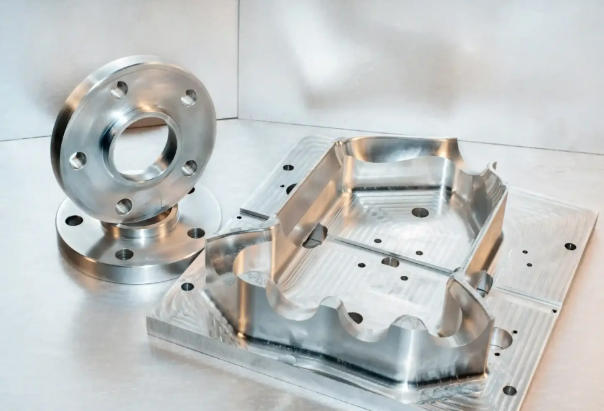
We test all materials to optimize tool selection, speeds, and coolant use—ensuring consistent quality across every part.
Surface Treatment & Finishing Options
After machining, we offer a range of surface treatment and finishing options to enhance part durability, appearance, and functionality. Our most popular services include:
- Grinding: Creates a smooth, flat surface (ideal for parts requiring tight fitment, e.g., engine components).
- Polishing: Delivers a glossy finish for visible parts (e.g., stainless steel medical tools, acrylic signage).
- Painting: Applies a corrosion-resistant coating (matte/gloss) for outdoor parts (e.g., automotive brackets).
- Coating: Options include powder coating (thick, scratch-resistant) for industrial parts and clear coating for acrylic.
- Anodizing: Adds a protective oxide layer to aluminum (available in custom colors) for electronics enclosures.
- Heat Treatment: Strengthens metals (e.g., titanium screws, steel tooling) by heating/cooling—improving hardness.
- Deburring: Removes sharp edges (critical for safety, e.g., consumer goods, medical devices).
The table below compares our finishing options by key factors:
| Finishing Option | Durability | Lead Time | Cost (per part, avg.) | Best For |
| Grinding | High | 1–2 days | 10–30 | Engine components, precision fits |
| Polishing | Medium | 2–3 days | 15–45 | Visible medical/acrylic parts |
| Painting | High | 2–4 days | 8–25 | Outdoor automotive/industrial parts |
| Coating (Powder) | Very High | 3–5 days | 20–50 | Heavy-duty industrial parts |
| Anodizing | Very High | 3–4 days | 12–35 | Aluminum electronics parts |
| Heat Treatment | Very High | 4–6 days | 25–70 | Titanium/steel high-stress parts |
| Deburring | Medium | 1 day | 5–12 | Safety-critical consumer/medical parts |
Tolerances & Quality Assurance
Tolerances and accuracy standards are critical for 3-axis parts—especially those used in aerospace, medical, or automotive applications. Our precision levels and tolerance ranges are tailored to your material and project, backed by rigorous measurement techniques and quality control processes:
| Material | Tolerance Range | Accuracy Standard Used | Measurement Technique |
| Stainless Steel | ±0.008–0.02mm | ISO 2768-1 (fine), ASME Y14.5 | CMM + Laser Scanner |
| Aluminum | ±0.01–0.03mm | ISO 2768-1 (fine), AMS 2750 | CMM + Digital Calipers |
| Titanium | ±0.009–0.025mm | ISO 2768-1 (fine), AMS 4928 | CMM + Optical Comparator |
| ABS Plastic | ±0.02–0.04mm | ISO 2768-1 (medium), ASTM D638 | CMM + Micrometer |
| Acrylic | ±0.015–0.035mm | ISO 2768-1 (medium), ASTM D792 | CMM + Profilometer |
Our quality control processes include:
- Pre-machining: Inspecting raw materials for defects (e.g., cracks in titanium, unevenness in acrylic) and verifying dimensions.
- In-process: Monitoring tool paths and axis alignment in real time via CNC software; periodic checks with calipers/micrometers.
- Post-machining: 100% inspection with CMMs (for critical parts) and surface finish testing; non-conforming parts are reworked or scrapped.
Documentation: We provide a detailed quality report with every order, including measurement data, inspection results, and compliance certificates (ISO 9001, FDA for medical parts).
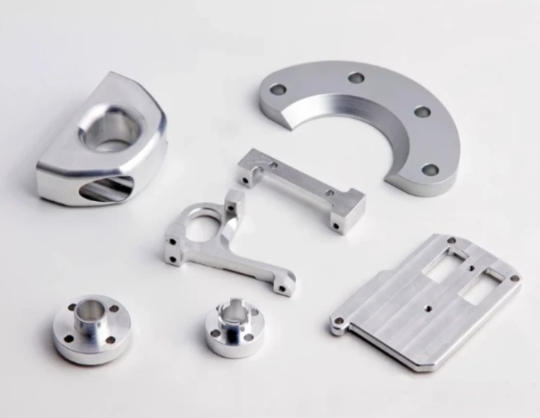
Key Advantages of 3-Axis CNC Machining
Compared to 4-axis/5-axis systems (more complex and costly) or manual machining (less precise), 3-Axis CNC Machining offers balanced benefits for most manufacturing needs:
- High Precision: With positioning accuracy of ±0.005mm and repeatability of ±0.003mm, it produces parts that fit seamlessly—critical for medical devices and aerospace components.
- Efficient Machining: Simplified tool paths (X/Y/Z only) reduce programming time, and fast cutting speeds (up to 10,000 RPM for aluminum) shorten production cycles.
- Versatility: It works with almost all common materials (metals, plastics, wood, acrylic) and handles diverse features (holes, slots, 3D curves)—making it a one-stop solution for prototyping and production.
- Cost-Effectiveness: Lower equipment and operational costs than multi-axis systems (no rotary axis maintenance); reduced labor costs due to automation (one operator can run 2–3 machines).
- Consistency and Repeatability: CNC programming ensures every part is identical—critical for high-volume orders (e.g., 50,000 plastic consumer goods casings).
- Complex Geometries: While it can’t handle undercuts, it excels at 3D shapes (e.g., curved automotive dash parts, contoured medical handles) using optimized X/Y/Z tool paths.
- Reduced Setup Time: Quick tool changes (via automated tool changers) and simple fixturing cut setup time by 30–40% compared to manual machining.
Industry Applications
3-Axis CNC Machining is the most widely used CNC technology—trusted across industries for its versatility and reliability. Here are its most common applications:
| Industry | Common Uses | Key Benefit of 3-Axis Machining |
| Aerospace | Aluminum brackets, stainless steel fasteners, composite panels | High precision for safety-critical parts |
| Automotive | Plastic interior parts, aluminum suspension brackets, brass connectors | Cost-effectiveness for high-volume production |
| Medical Devices | Titanium screws, stainless steel surgical tools, plastic device casings | Precision and FDA-compliant processes |
| Industrial Manufacturing | Steel machine frames, composite conveyor parts, copper heat exchangers | Versatility for diverse part types |
| Electronics | Aluminum heat sinks, plastic circuit board enclosures, brass terminals | Ability to machine small, precise features |
| Defense | Steel weapon components, aluminum vehicle parts, plastic communication casings | Consistency for replacement parts |
| Tool and Die Making | Steel die inserts, plastic mold cores, custom cutting tools | Efficiency for low-to-medium volume runs |
| Prototyping | Rapid prototypes of new products (plastics, aluminum, acrylic) | Fast setup and low cost for small batches |
| Consumer Goods | Acrylic display cases, wood furniture components, plastic toy parts | Cost-effectiveness for mass production |
For example, in the consumer goods industry, we produce 20,000 acrylic phone stands monthly with consistent dimensions—thanks to 3-axis machining’s repeatability. In medical devices, our titanium screws meet ±0.008mm tolerances, ensuring safe implantation.
Case Studies: Success Stories
Our 3-Axis CNC Machining services have helped clients across industries solve production challenges—from prototyping to high-volume manufacturing. Below are two successful projects showcasing our expertise in precision, efficiency, and versatility:
Case Study 1: Automotive Plastic Interior Part Manufacturer
- Challenge: The client needed 50,000 ABS plastic dashboard brackets monthly for a new car model. Each bracket required 4 holes (0.5mm diameter), a curved edge, and a tolerance of ±0.03mm. Their previous supplier used manual machining, which caused 12% of parts to fail (misaligned holes, uneven curves) and had a 4-week lead time—delaying the car’s launch.
- Solution: We used 3-Axis CNC Machining with custom vacuum fixtures (to secure thin ABS sheets) and HSS end mills (optimized for plastics). We programmed tool paths to cut the curved edge via synchronized X/Y/Z movements, then drill the holes in one setup. Mist coolant was used to prevent ABS warping, and our automated tool changer reduced setup time between batches. We also ran 8 machines 24/7 to meet high-volume demand.
- Results:
- Defect rate dropped from 12% to 0.8%—only 400 parts failed per month (vs. 6,000 previously).
- Lead time shortened from 4 weeks to 10 days—helping the client meet their car launch deadline.
- Production cost per bracket decreased by 40% (reduced labor from automation and fewer defects).
- Client Testimonial: “3-axis CNC transformed our dashboard bracket production. The consistency and speed let us hit our launch date, and the cost savings were a huge bonus. We’ve expanded our order to include other interior parts!” — Mike T., Automotive Production Director.
- Before and After: Manual parts had jagged edges and misaligned holes; CNC parts featured smooth curves and perfectly spaced holes that fit seamlessly into dashboards.