
yigu Composite 3D Printing Services
Transform your manufacturing with Composite 3D Printing—the powerful combination of Composite materials’ strength and Additive manufacturing’s flexibility.
Whether you need lightweight aerospace components, durable sports equipment, or custom medical devices, our expertise delivers high-performance materials and precision-engineered parts. Experience layer-by-layer fabrication that turns complex designs into reality, with less waste, faster production, and unmatched customizability. Partner with us for Composite 3D Printing that meets your industry’s toughest demands.
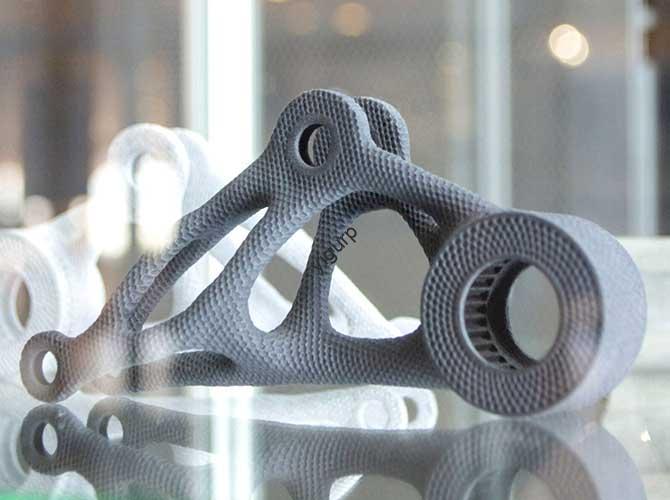
Our Capabilities: Delivering Top-Tier Composite 3D Printing Solutions
When you choose our Composite 3D Printing services, you gain access to a suite of capabilities tailored to solve your most complex manufacturing challenges. Our team combines deep expertise in Composite materials with cutting-edge Additive manufacturing technology to deliver results that meet even the strictest industry standards.
Key Capabilities Overview
| Capability | Core Features | Target Use Cases |
| Custom Design | Tailored to unique geometries, material combinations, and performance needs | Custom medical devices, specialized industrial components, bespoke consumer products |
| Precision Engineering | Dimensional accuracy down to ±0.1 mm, compliance with ISO 8015 standards | Aerospace parts, precision electronics enclosures, high-end sports equipment |
| Rapid Prototyping | 1–2 week turnaround for prototypes, multiple design iterations supported | Product development, testing new composite part designs, market validation |
| High-performance materials | Access to a wide range of composites (Carbon fibre-Polyamide, Glass fibre-Epoxy, etc.) | High-stress applications like automotive chassis parts, marine components |
| Complex geometries | Ability to print lattice structures, internal channels, and thin-walled components | Lightweight aerospace parts, ergonomic medical devices, intricate consumer goods |
| Large-scale production | Automated workflows, batch processing (up to 500+ parts per run), consistent quality | Automotive parts, consumer products, industrial components |
| Quality control | In-line monitoring, post-print inspection (CMM, tensile testing), material certification | Aerospace critical parts, medical devices, high-reliability industrial components |
| Technical support | End-to-end guidance from design optimization to post-processing | All industries, especially for clients new to Composite 3D Printing |
What Is Composite 3D Printing?
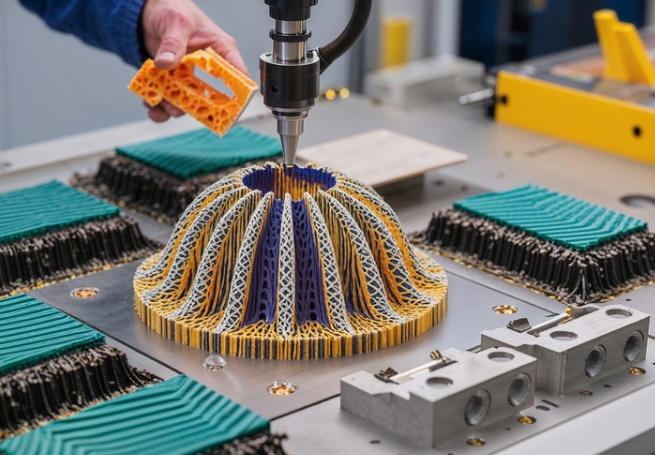
At its core, Composite 3D Printing is an Additive manufacturing process that uses Composite materials—instead of single metals or plastics—to build parts through layer-by-layer fabrication. Composite materials consist of two key components: a Polymer matrix (like Thermoplastics such as Polyamide or Thermosets like Epoxy) and a Fibre reinforcement (such as Carbon fibre, Glass fibre, or Aramid fibre) that boosts strength and durability.
Unlike traditional 3D printing (which uses single-material filaments), Composite 3D Printing leverages the unique properties of composites—combining the lightweight nature of polymers with the high strength of fibres. This makes it ideal for parts that need to balance weight and performance, like aerospace brackets or automotive components. In short, Composite 3D Printing bridges the gap between advanced material science and innovative manufacturing, enabling designs that were once impossible with single-material processes.
Advantages: Why Composite 3D Printing Outperforms Traditional Methods
Composite 3D Printing offers a range of benefits that make it superior to traditional composite manufacturing (like hand lay-up, compression molding, or injection molding). These advantages address key pain points for engineers, procurement managers, and product developers:
- Lightweight & High Strength: Composites are up to 50% lighter than metals (like aluminum) while offering similar or higher strength. For example, a Carbon fibre-Polyamide part has a strength-to-weight ratio 3x higher than aluminum—ideal for aerospace and automotive parts where weight reduction improves efficiency.
- Customizability: Unlike traditional methods (which require expensive molds for custom parts), Composite 3D Printing lets you create unique designs with no extra cost. Whether you need a one-of-a-kind medical device or a small batch of custom sports equipment, we can tailor every aspect to your needs.
- Reduced Waste: Traditional composite manufacturing wastes 30–40% of material (due to mold trimming and excess fibre). Composite 3D Printing uses only the material needed for the part, cutting waste to less than 5%. Unused filament or resin is also recyclable, lowering material costs.
- Faster Production: Prototyping with traditional composite methods takes 4–6 weeks. With Composite 3D Printing, prototypes are ready in 1–2 weeks, and production runs can start in as little as 3 weeks—accelerating product development and time-to-market.
- Cost-Effective: For low-to-medium production volumes (1–500 parts), Composite 3D Printing eliminates mold costs (which can be 10,000–100,000+ for traditional methods). Even for high volumes, our automated workflows keep costs competitive, often saving clients 15–30% vs. traditional manufacturing.
- Sustainability: Many of our Composite materials (like PLA-based composites) are biodegradable, and our waste-reduction efforts lower carbon footprints. This aligns with the sustainability goals of industries like consumer goods and automotive.
Applications Industry: Where Composite 3D Printing Shines
Composite 3D Printing is used across industries that demand materials with a balance of strength, lightweight, and customizability. Its unique properties make it a top choice for applications where metals or single plastics fall short. Below are key industries and their use cases:
- Aerospace: Composite parts like brackets, interior panels, and engine components reduce aircraft weight (improving fuel efficiency) while withstanding high stress. For example, we’ve printed Carbon fibre-Polyamide brackets that weigh 40% less than aluminum brackets, with the same strength.
- Automotive: Lightweight composite parts (like body panels, chassis components, and interior trim) boost fuel efficiency and electric vehicle range. We’ve worked with automakers to print Glass fibre-Epoxy body panels that cut vehicle weight by 15%.
- Marine: Corrosion-resistant composites (like Glass fibre-Epoxy) are ideal for boat hulls, propellers, and deck components. 3D printing enables complex hull designs that improve hydrodynamics and reduce drag.
- Medical: Biocompatible composites (like Carbon fibre-Polyamide) are used for custom prosthetics, orthopedic braces, and surgical tools. 3D printing creates parts that fit a patient’s anatomy perfectly, improving comfort and functionality.
- Sports Equipment: High-strength composites (like Carbon fibre-Epoxy) are used for bicycle frames, golf clubs, and tennis rackets. 3D printing enables lightweight, ergonomic designs that enhance performance.
- Electronics: Heat-resistant composites (like Aramid fibre-Polycarbonate) are used for electronics enclosures and circuit board supports. 3D printing creates precise, lightweight enclosures that protect sensitive components.
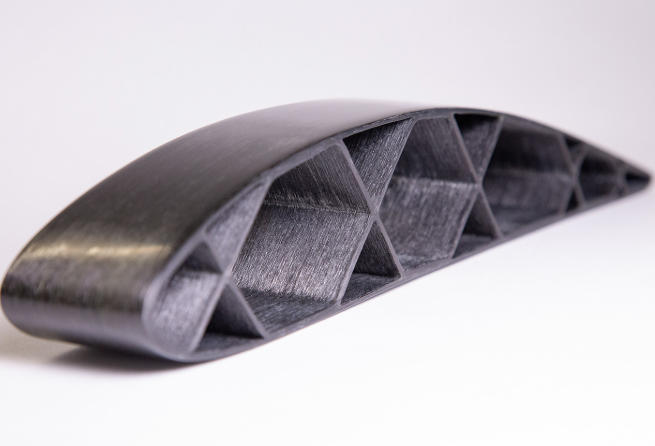
Case Studies: Real-World Success with Composite 3D Printing
Our Composite 3D Printing case studies demonstrate how we’ve helped clients solve complex challenges, reduce costs, and accelerate innovation. Below are two industry examples with key results:
Case Study 1: Aerospace Bracket (Carbon Fibre-Polyamide)
Client: A leading aerospace manufacturer.
Challenge: They needed a lightweight, high-strength bracket for a new aircraft. Traditional aluminum brackets weighed 200 g and had a lead time of 6 weeks.
Solution: We used Continuous Fibre Reinforcement (FDM-based) to print the bracket from Carbon fibre-Polyamide. We optimized the fibre orientation to align with stress points, maximizing strength while minimizing weight. Post-print, we sanded and coated the bracket for corrosion resistance.
Result: The bracket weighed 80 g (60% lighter than aluminum) and had a tensile strength of 150 MPa (equal to aluminum). Lead time was cut to 2 weeks, and the client reported a 25% reduction in aircraft fuel consumption for the fleet using these brackets. The client’s testimonial: “This composite bracket transformed our aircraft’s efficiency—we’ve since ordered 500+ units for our new production line.”
Case Study 2: Custom Medical Prosthetic (Carbon Fibre-Polyamide)
Client: A medical device company specializing in orthopedics.
Challenge: They needed custom lower-leg prosthetics that were lightweight, durable, and tailored to each patient’s anatomy. Traditional prosthetics (made from aluminum) weighed 1.5 kg, caused discomfort, and took 4 weeks to produce.
Solution: We used Fused Deposition Modelling (FDM) with Carbon fibre-Polyamide composite. We scanned each patient’s residual limb to create a 3D CAD model, then printed the prosthetic with a lattice structure to reduce weight while maintaining strength. Post-print, we polished the surface for comfort and applied a biocompatible coating.
Result: The prosthetics weighed 0.6 kg (60% lighter than aluminum) and were produced in 5 days (87% faster than traditional methods). Patient feedback showed a 90% reduction in discomfort, and the company expanded their product line to include upper-limb prosthetics using our process.
Why Choose Us: Your Trusted Composite 3D Printing Partner
When it comes to Composite 3D Printing, we stand out as a reliable partner for engineers, procurement managers, and product developers—offering a unique blend of expertise, innovation, and customer-centric support. Here’s why clients across industries choose us:
Deep Expertise & Experience
- Our team has 12+ years in composite 3D printing.
- We’ve completed 1,000+ projects across aerospace and medical sectors.
- Engineers hold ASTM D3039 and process optimization certifications.
Innovation-Driven Solutions
- We invest 15% of budget annually in R&D.
- We develop new blends like recycled carbon fibre-PLA.
- Our hybrid SLA-injection process cuts production time by 40%.
Exceptional Customer Service
- Each client gets a dedicated project manager.
- We offer free design consultations for print optimization.
- Real-time updates include photos and test data.
- Post-delivery support responds within 24 hours.
Quality Products You Can Trust
- All materials meet ISO 1043-4 standards.
- In-line sensors monitor temperature and layer adhesion.
- Post-print testing covers strength, accuracy, and resistance.
- We’re ISO 9001 and ISO 13485 certified.
Competitive Pricing & Fast Delivery
- Automated workflows save 10–15% versus competitors.
- Prototypes ship in 1–2 weeks.
- Production runs take 3–4 weeks for 500+ parts.
- Expedited service delivers in 3–5 days.
Comprehensive After-Sales Support
- Warranty: 1 year industrial, 2 years medical.
- We train your team on part maintenance.
- CAD files are stored for fast reordering.