
Our 5-Axis CNC Machining Services
Unlock precision, efficiency, and versatility for your complex manufacturing needs with our 5-Axis CNC Machining services.
Whether you’re crafting aerospace components, medical devices, or automotive parts, we deliver tight tolerances, reduced setup time, and custom solutions that traditional machining can’t match. Partner with us to turn your most intricate designs into high-quality, production-ready parts—on time and within budget.
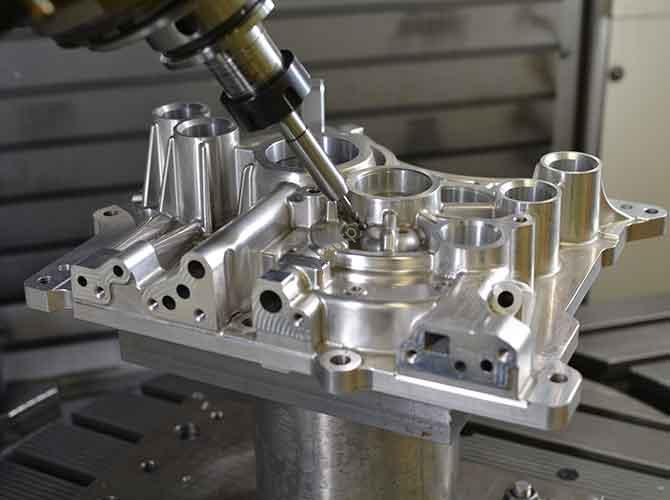
Our 5-Axis CNC Machining Capabilities
We specialize in turning challenging designs into reality with our industry-leading 5-Axis CNC Capabilities. Our services blend precision, customization, and advanced engineering to meet the unique needs of every client.
Here’s a breakdown of our core offerings, aligned with key Precision Machining Services and Advanced Machining Solutions:
| Capability | Description | Ideal For |
| Custom Machining | Tailored processes for one-off prototypes or high-volume production runs. | Medical devices, custom industrial equipment. |
| High-End CNC Machining | Ultra-precise machining for parts requiring tight tolerances (down to ±0.0005”). | Aerospace components, optical parts. |
| Complex Part Manufacturing | Single-setup machining for 3D geometries (e.g., curved surfaces, undercuts). | Automotive powertrain parts, turbine components. |
| Precision Engineering | Collaborative design support to optimize parts for manufacturability. | New product development, prototype refinement. |
| Tailored Machining Services | Flexible workflows to match material type, volume, and quality requirements. | Consumer goods, defense industry parts. |
No matter the project—from small plastic components to large metal structures—we ensure consistency and quality at every step.
What Is 5-Axis CNC Machining?
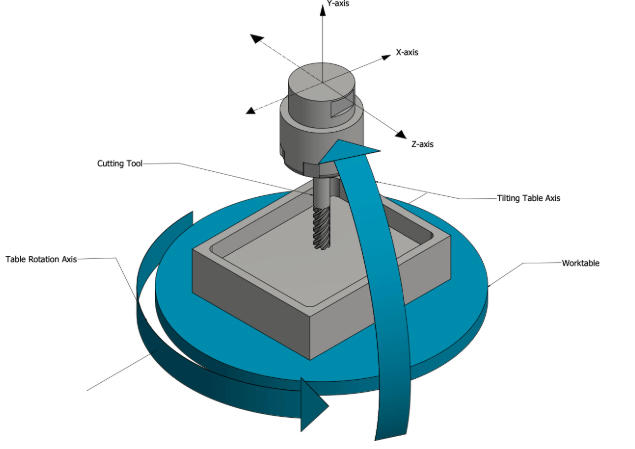
At its core, 5-Axis CNC Machining is an advanced manufacturing technology that allows a machine tool to move a workpiece (or cutting tool) along five different axes simultaneously. Unlike Traditional CNC (which typically uses 3 axes: X, Y, Z), this multi-axis capability enables machining of complex geometries in a single setup.
To clarify the basics, let’s break down key terms in the CNC Machining Basics and Machine Tool Axes landscape:
| Term | Definition |
| 5-Axis Machining | Machining process using 5 axes (X, Y, Z + 2 rotational axes: A, B, or C) for simultaneous movement. |
| Multi-Axis Machining | An umbrella term for processes with 4+ axes; 5-axis is the most widely used for complex parts. |
| Traditional CNC | 3-axis machining (X, Y, Z) that requires multiple setups for complex shapes, increasing time and error risk. |
| Machining Technology Overview | 5-axis machining integrates computer programming, tool path optimization, and high-precision hardware to deliver consistent results. |
This technology is a game-changer for industries needing intricate parts—think turbine blades, dental implants, or aerospace brackets—where 5-Axis CNC vs Traditional CNC performance gaps are most visible.
The 5-Axis CNC Machining Process
Our 5-Axis CNC Machining Process follows a structured workflow to ensure accuracy, efficiency, and repeatability. Each step is optimized to minimize errors and meet your specifications:
- Design & Programming: We convert your 3D CAD models into machine-readable code using advanced CNC Programming software. This step includes Tool Path Generation—mapping the cutting tool’s movement to avoid collisions and ensure smooth operation.
- Machine Setup: Our technicians mount the workpiece and cutting tools, calibrate axes, and perform test runs to verify alignment. Proper Machine Setup is critical for achieving tight tolerances.
- Machining Operations: The machine executes the programmed tool paths, cutting and shaping the material across all five axes. This step eliminates the need for multiple setups, reducing production time.
- Quality Control: We inspect parts using precision tools (e.g., CMMs, calipers) to ensure they meet Tolerance Standards (more on this later). Quality Control in Machining includes dimensional checks and surface finish assessments.
- Post-Processing Steps: Parts may undergo Surface Treatment (e.g., anodizing, polishing) or assembly before final delivery. Post-processing enhances durability, aesthetics, and functionality.
This Step-by-Step Machining workflow typically reduces lead times by 30–50% compared to traditional 3-axis methods, according to industry data.
Materials for 5-Axis CNC Machining
We work with a wide range of Machinable Materials to suit diverse industry needs. The right material selection directly impacts part performance, cost, and machining complexity—our team helps you choose the best option for your project.
Below is a breakdown of common Materials for 5-Axis CNC Machining and their key properties:
| Material Category | Examples | Key Properties | Ideal Applications |
| Metal Machining Materials | Aluminum, Stainless Steel, Titanium | High strength, durability, heat resistance | Aerospace, automotive, defense |
| Aluminum Machining | 6061, 7075 | Lightweight, corrosion-resistant, easy to machine | Consumer electronics, automotive parts |
| Stainless Steel Machining | 304, 316 | Rust-resistant, strong, hygienic | Medical devices, food processing equipment |
| Titanium Machining | Ti-6Al-4V | High strength-to-weight ratio, biocompatible | Aerospace components, dental implants |
| Plastic Machining | PEEK, Acetal, Nylon | Low weight, chemical resistance, low friction | Electronics enclosures, medical tools |
| Composite Materials | Carbon fiber-reinforced polymer (CFRP) | High strength, lightweight | Aerospace structures, high-performance parts |
| Exotic Metals | Inconel, Hastelloy | Extreme heat/corrosion resistance | Jet engine parts, oil/gas equipment |
Our Material Selection for Machining experts consider factors like cost, lead time, and part function to recommend the optimal material for your project.
5-Axis CNC Machining Tolerances & Quality Assurance
Machining Tolerances—the allowable deviation from a part’s specified dimensions—are critical for ensuring functionality and fit. Our 5-axis machines deliver Precision Tolerances that meet or exceed industry standards, including ISO Tolerances (e.g., ISO 8062).
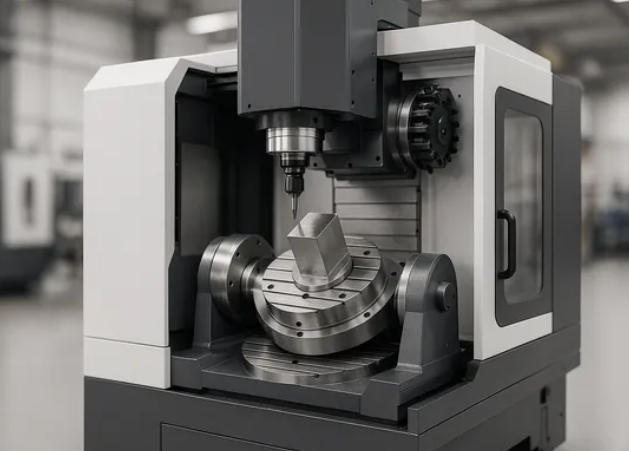
Here’s how our tolerance capabilities compare to traditional machining:
| Tolerance Type | Our 5-Axis Capability | Traditional 3-Axis Capability | Key Application |
| Dimensional Accuracy | ±0.0005” (0.0127 mm) | ±0.002” (0.0508 mm) | Aerospace fasteners, optical parts |
| Tight Tolerances | ±0.001” (0.0254 mm) for complex geometries | ±0.005” (0.127 mm) for complex geometries | Medical implants, precision gears |
| Geometric Tolerances | Compliant with GD&T (ASME Y14.5) | Limited GD&T compliance for complex shapes | Automotive powertrain components |
To guarantee quality, we use rigorous Inspection Methods such as:
- Coordinate Measuring Machines (CMMs) for 3D dimensional checks
- Optical comparators for surface profile inspections
- Force torque testing for assembly-ready parts
Our Quality Assurance process ensures 99.9% of parts meet your specifications—no exceptions.
Advantages of 5-Axis CNC Machining
The Advantages of 5-Axis CNC Machining make it the preferred choice for complex, high-precision parts. Compared to traditional methods, it offers tangible benefits for productivity, cost, and quality:
| Advantage | Description | Impact |
| Increased Productivity | Single-setup machining reduces production time by 30–50%. | Faster time-to-market for your products. |
| Enhanced Precision | Simultaneous 5-axis movement eliminates setup errors, improving dimensional accuracy. | Fewer defects and reworks, lowering costs. |
| Improved Efficiency | Optimized tool paths reduce cutting time and tool wear. | Lower material waste and tool replacement costs. |
| Reduced Setup Time | No need to reposition the workpiece for complex cuts. | Higher machine utilization and shorter lead times. |
| Complex Geometry | Machines intricate shapes (e.g., undercuts, curved surfaces) that 3-axis can’t handle. | More design flexibility for innovative products. |
| Single Setup Machining | Reduces human error from multiple setups. | Consistent quality across high-volume runs. |
| Cost Savings | Faster production and fewer errors lower total manufacturing costs by 20–40%. | Higher profitability for your projects. |
| Faster Turnaround Time | Streamlined workflow delivers parts in days (not weeks) for most projects. | Better responsiveness to market demands. |
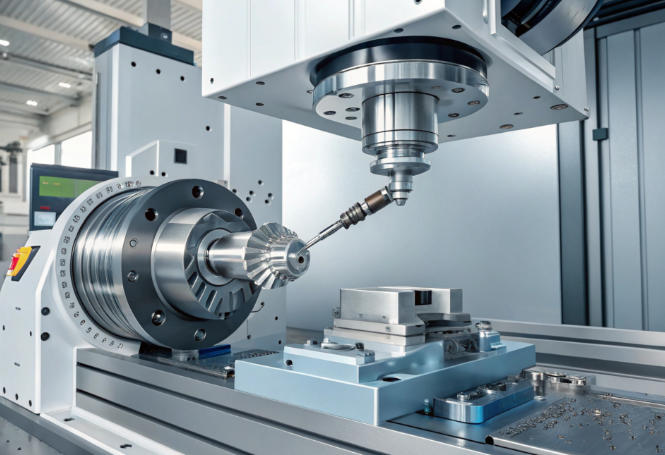
These Benefits of Multi-Axis Machining make it ideal for industries where precision and speed are non-negotiable.
5-Axis CNC Machining Applications by Industry
5-Axis CNC Machining Applications span nearly every manufacturing sector, thanks to its versatility and precision. Below are key industries we serve and their specific needs:
| Industry | Key Machining Needs | Examples of Parts |
| Aerospace Machining | Lightweight, high-strength parts with tight tolerances. | Turbine blades, aircraft brackets, engine components. |
| Automotive Machining | High-volume production of complex, durable parts. | Gearboxes, suspension components, electric vehicle (EV) parts. |
| Medical Device Machining | Biocompatible materials and ultra-precise tolerances. | Dental implants, surgical instruments, prosthetics. |
| Electronics Machining | Small, lightweight parts with intricate features. | Circuit board enclosures, connector housings. |
| Industrial Equipment Machining | Heavy-duty parts for harsh environments. | Pump housings, gear shafts, hydraulic components. |
| Tool and Die Machining | Custom molds and dies with complex cavities. | Injection molds, stamping dies. |
| Consumer Goods Machining | Aesthetically pleasing parts with consistent quality. | High-end furniture hardware, electronic device casings. |
| Defense Industry Machining | Rugged parts that meet military standards. | Weapon components, vehicle armor parts. |